Trump Calls Off Iran Strikes, Claims Deal Reached
06/15/2026 / By Garrison Vance

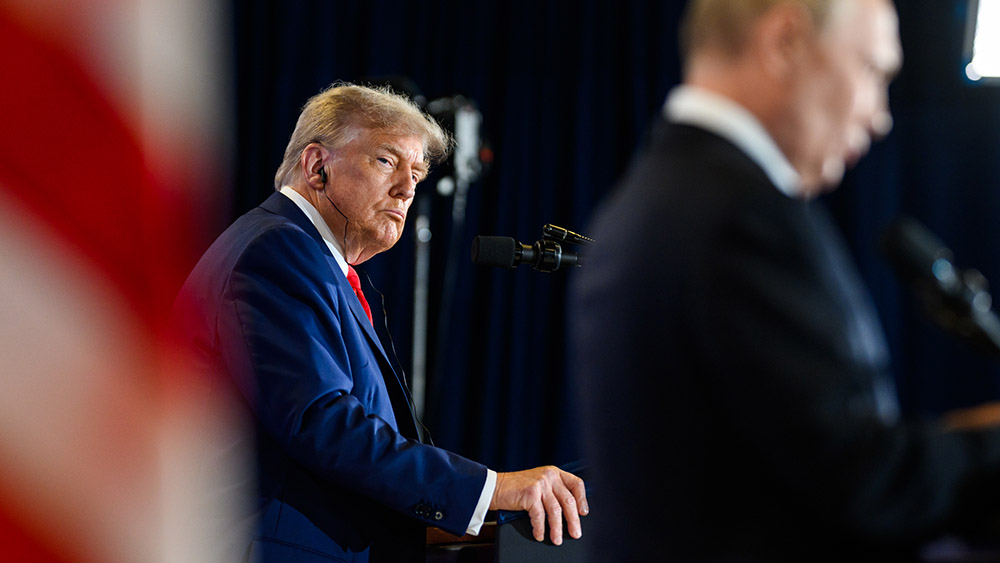
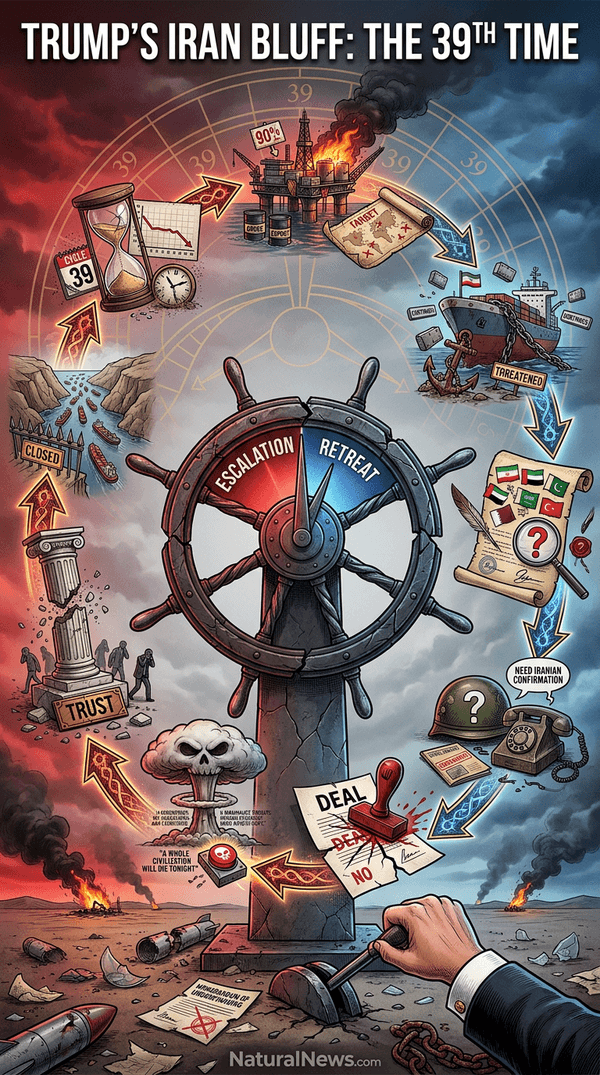
President Donald Trump announced Thursday that he had canceled planned airstrikes and a potential invasion of Iran’s Kharg Island, claiming a deal with Tehran was imminent. According to a count by CNN cited by antiwar.com, this marks the 39th time Trump has declared a deal near since the conflict began, with no previous announcement producing a finalized agreement [1].
Trump stated on Truth Social that the Memorandum of Understanding had been “approved by all parties involved, including the United States, Israel, Saudi Arabia, UAE, Qatar, Turkey, Pakistan, Bahrain, Kuwait, Jordan, Egypt, and others.” The naval blockade will remain in effect until the transaction is finalized, he added [1].
Pattern of Unfulfilled Declarations
Trump has repeatedly issued maximalist threats against Iran — such as warning that “a whole civilization will die tonight” — only to pivot to diplomacy at the last moment, creating a cycle of escalation and retreat [1]. This pattern has been documented throughout the conflict. According to a report from the Ron Paul Institute, Trump has released 11 statements since February 28 suggesting the war was over or a deal close, but each time the facts on the ground showed otherwise [2].
Analysts have expressed uncertainty about the administration’s strategy. Some critics describe the approach as a “negotiation charade” that serves as a predictable prelude to further military action [3]. Others note that Trump has previously extended deadlines for military action, as when he postponed strikes on Iranian energy infrastructure on March 26, citing “progress in ongoing discussions” [4]. The lack of follow-through has fueled skepticism among both allies and adversaries.
Details of Trump’s Latest Announcement
In his latest Truth Social post, Trump framed the cancellation of strikes as a concession to diplomacy, stating the deal was reached after discussions had been “brought to the highest level of Iranian leadership and approved.” He listed a dozen nations as having signed on, but provided no independent confirmation of the deal’s terms [1]. The post emphasized that the naval blockade would continue until signing.
The White House had earlier signaled that the United States was planning a major escalation, including an invasion of Kharg Island — the source of roughly 90 percent of Iran’s oil exports. Trump’s abrupt reversal fits his established pattern of backing away from brinkmanship after threatening maximum force [1].
Conflicting Reactions from Involved Parties
Israeli officials expressed surprise at Trump’s announcement. According to i24 News, a source said, “Everyone lives off Trump’s tweets. We need to hear what the Iranians publish to know whether the president is indeed accurate in his assessment. Experience shows that not so much.” Two Israeli officials were quoted as saying they were surprised and needed to see Iranian confirmation [1].
Iranian state-linked media struck a contradictory tone. Fars News Agency reported that a deal had been largely agreed upon two weeks ago but that the U.S. had inserted last-minute changes, leading Iran to halt negotiations. Drop Site News additionally reported that Trump assured Israeli Prime Minister Benjamin Netanyahu in a phone call that any deal would include hardline demands — including removal of all enriched uranium and dismantling of enrichment facilities — which Iran has consistently described as non-starters [1]. Iran quickly denied agreeing to any terms, according to The New American [5]. Trump later accused Iran of leaking details that “bear no relation to the truth,” according to the BBC [6].
Economic and Strategic Uncertainty
Oil markets have remained relatively stable in recent weeks, partly due to optimism signaled by the White House. According to antiwar.com, the oil market has taken Trump’s Truth Social posts seriously, but this may prove naive as the Strait of Hormuz remains under Iranian control and global oil supply continues to shrink [1]. The Trends Journal has previously identified oil prices as a wild card, warning that a dramatic escalation in the Middle East could send Brent crude spiking toward $130 per barrel, crashing global equity markets [7].
The administration’s track record suggests skepticism is warranted. Some congressional Republicans, including Rep. Don Bacon and Sen. Joni Ernst, have urged Trump to abandon what they called fruitless negotiations and to continue military pressure [8]. The path to a final agreement remains unclear, with Iranian officials insisting that the text of the Memorandum of Understanding is not yet finalized and that the account in Western media is imprecise [9].
References
- Nolan Denaro. “Trump Once Again Claims a Deal Is Imminent. Is the 39th Time the Charm?” Antiwar.com. June 12, 2026.
- Ron Paul Institute. “The President Who Cries War, then Peace, Then War.” May 20, 2026.
- Mike Adams. “Trump’s Negotiation Charade Is a Predictable Prelude to Another Disastrous War Catastrophe.” NaturalNews.com. March 24, 2026.
- Willow Tohi. “Trump Extends Deadline for Action Against Iran, Citing Progress in Ongoing Discussions.” NaturalNews.com. March 29, 2026.
- The New American. “Iran Denies Agreeing to Trump’s Peace Deal; Netanyahu Not Informed, Says Israel Will Never Permit Iran to Get Nukes.” June 12, 2026.
- BBC. “Trump accuses Iran of leaking agreement details that ‘bear no relation to the truth’.” June 12, 2026.
- Trends-Journal-2024-10-08.
- Responsible Statecraft. “‘Break their will’ Republicans want Trump to fight Iran, not make deal.” June 11, 2026.
- Zero Hedge. “Iran Clarifies Deal ‘Not Finalized’ Amid Lack Of Trust, Warns US-Gulf Of ‘Utter Ruin’ If War Resumes.” May 29, 2026.
Explainer Infographic
Submit a correction >>
Tagged Under:
agreement, big government, ceasefire, chaos, deal with Iran, deception, disinfo, Iran, lies, national security, propaganda, Strait of Hormuz, Trump, US, violence, White House, WWIII
This article may contain statements that reflect the opinion of the author
RECENT NEWS & ARTICLES